

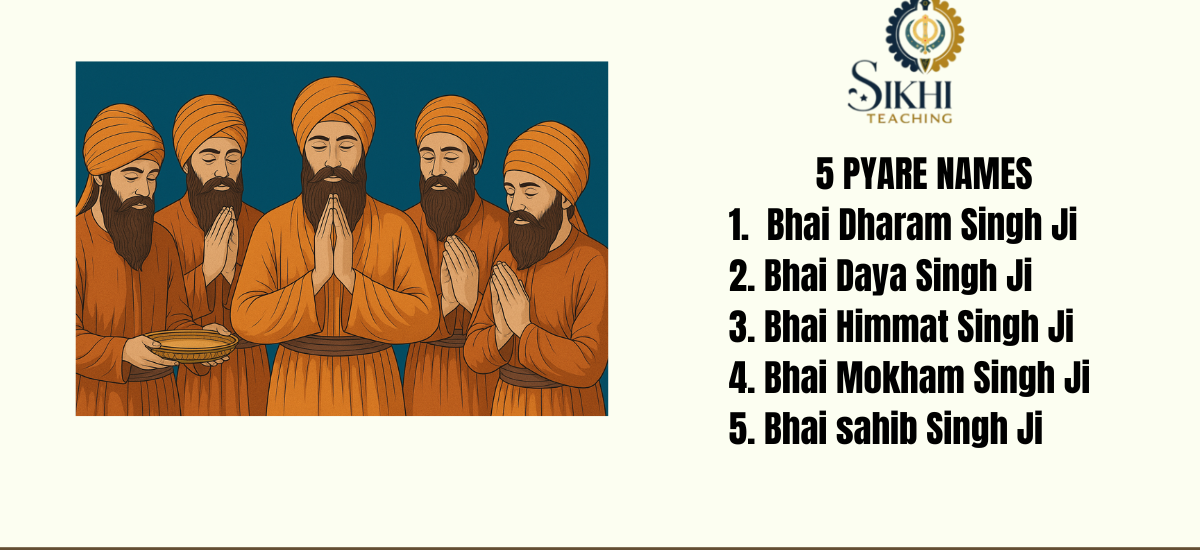
Panj Pyare Names are Bhai Daya Singh, Bhai Dharam Singh, Bhai Himmat Singh, Bhai Mohkam Singh, and Bhai Sahib Singh. In Sikh history, these five persons are referred to as the “Five Beloved Ones.” When Guru Gobind Singh Ji called for volunteers willing to sacrifice their lives for their faith in 1699, they were the first Sikhs to come forward. The Khalsa, or community of initiated Sikhs, was founded as a result of their bravery and selflessness.
What does “Panj Pyare” mean?
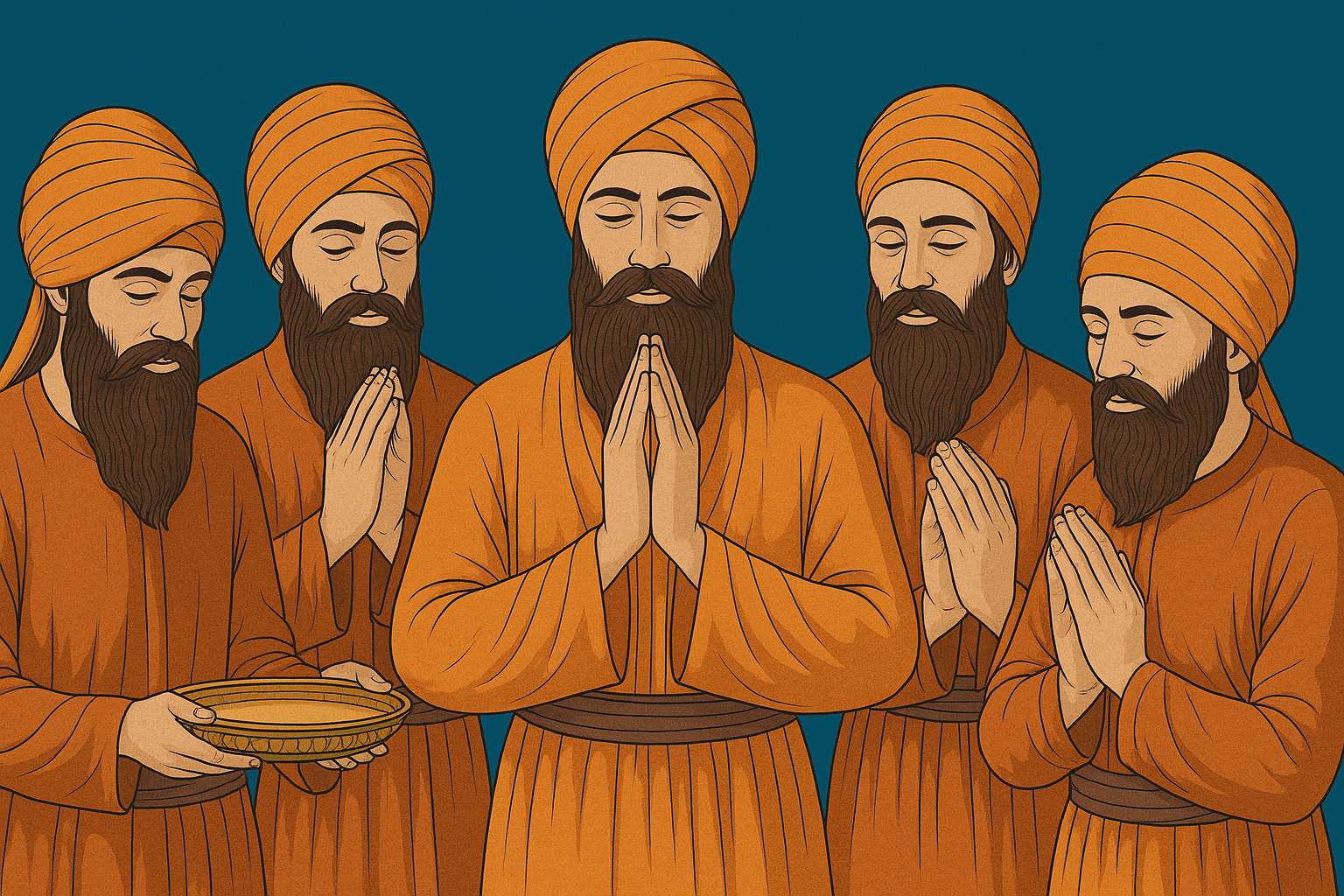
“Pyare” means adored, while “Panj” signifies five. Thus, the literal meaning of Panj Pyare is “Five Beloved Ones.” They exhibited courage, trust, and love for Guru Gobind Singh Ji, which is why they are highly respected.
The Story Behind the 5 Pyare Names
Guru Gobind Singh Ji assembled thousands of Sikhs at Anandpur Sahib on Vaisakhi in 1699. “Who is ready to give their head for their faith?” he said, shocking everyone. Everyone was initially shocked. Then five Sikhs rose, one by one. They became the first Khalsa Sikhs after Guru Ji handed them Amrit, or holy nectar.
The First of the Panj Pyare – Bhai Daya Singh Ji (1661 - 1708 CE)
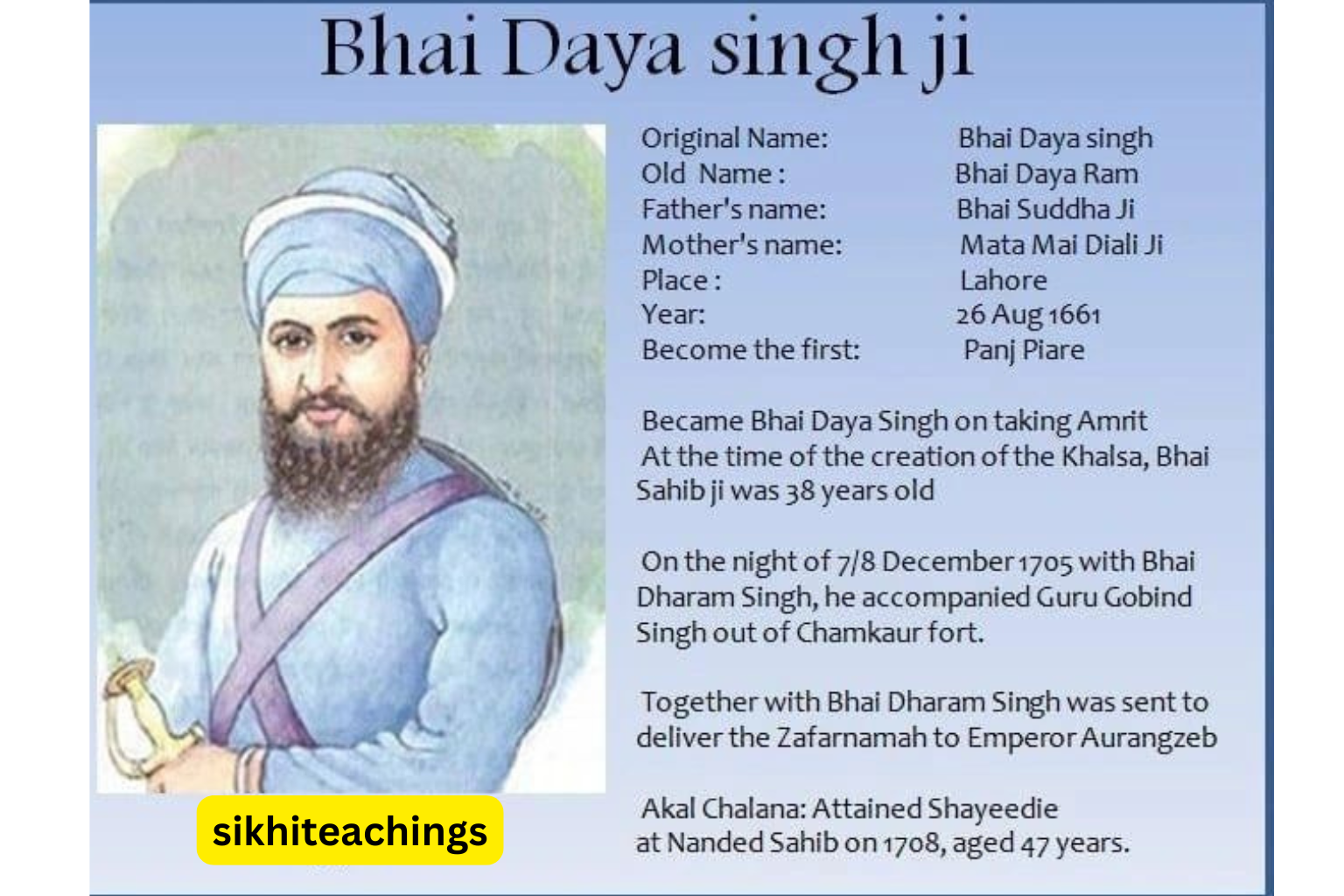
The very first Sikh who stood up when Guru Gobind Singh Ji asked for volunteers was Bhai Daya Singh.
He was born in 1661 in Lahore (now in Pakistan) as Daya Ram.
His parents were Suddha and Mai Dayali, from the Sobhi Khatri family.
He worked as a shopkeeper before joining Guru Ji.
In 1699 at Anandpur Sahib, when he was 38 years old, he offered his life to Guru Ji and became part of the Khalsa.
Sadly, he was martyred in 1708 at Nanded at the age of 47.
Daya Ram abandoned his caste identity and adopted the name Daya Singh upon joining the Khalsa. Singh means “lion,” while Daya means “kind, merciful, compassionate.” Thus, his name embodies the Panj Pyare’s core characteristics of kindness and bravery.
The Second of the Panj Pyare – Bhai Dharam Singh Ji (1699 - 1708 CE)
The next brave Sikh to step forward was Bhai Dharam Singh.
He was born in 1666 in Hastinapur, near the River Ganges (close to present-day Delhi), as Dharam Das.
His parents were Sant Ram and Mai Sabho, and they were from the Jatt community.
He worked as a farmer.
At the 1699 Vaisakhi at Anandpur Sahib, when he was 33 years old, he joined the Khalsa.
He gave his life in 1708 at Nanded at the age of 42.
Dharam Das was changed to Dharam Singh when he joined Khalsa. Dharam translates to “righteous living,” or leading an honest and true existence. He demonstrated that sticking up for what is right is the path to true strength.
The Third of the Panj Pyare – Bhai Himmat Singh JI (1661 - 1705 CE)
The third volunteer was Bhai Himmat Singh, another fearless devotee.
He was born on January 18, 1661 in Jagannath Puri (Orissa) as Himmat Rai.
His parents were Gulzaree and Dhanoo from the Jheeaur clan.
He worked as a water carrier.
At 38 years old, in 1699, he became part of the Khalsa at Anandpur Sahib.
He gave his life bravely at the Battle of Chamkaur in 1705 at the age of 44.
The Fourth of the Panj Pyare – Bhai Muhkam Singh ji (1663 - 1705 CE)
The fourth Sikh to step forward was Bhai Muhkam Singh.
He was born on June 6, 1663 in Dwarka (Gujarat) as Muhkam Chand.
His parents were Tirath Chand and Devi Bai from the Chhimba family.
He worked as a tailor and cloth printer.
In 1699 at Anandpur Sahib, when he was 36 years old, he became Khalsa.
He fought bravely and died at the Battle of Chamkaur in 1705, at the age of 44.
After taking Amrit, Muhkam Chand became Muhkam Singh. Muhkam means “strong and firm,” which suited him perfectly as he fought side by side with Guru Gobind Singh Ji.
The Fifth of the Panj Pyare – Bhai Sahib Singh Ji (1662 - 1705 CE)
Finally, the fifth to step forward was Bhai Sahib Singh.
He was born on June 17, 1663 in Bidar (Karnataka, India) as Sahib Chand.
His parents were Guru Narayana and Ankamma Bai from the Nai (barber) family.
He worked as a barber before joining Guru Ji.
In 1699, at the age of 37, he took Amrit at Anandpur Sahib.
He fought bravely and was martyred at the Battle of Chamkaur in 1705, at the age of 44.
When he joined the Khalsa, Sahib Chand became Sahib Singh. Sahib means “master” or “lordly.” He lived up to his name by showing great devotion and leadership while defending Guru Ji.
In short: All five of 5 pyare – Daya Singh, Dharam Singh, Himmat Singh, Muhkam Singh, and Sahib Singh – gave up their old lives and castes to join the Khalsa. They came from different parts of India, different jobs, and different castes, but Guru Gobind Singh Ji made them equal and united. Their names carry deep meaning, and their sacrifice still inspires Sikhs all over the world.
Why are the Panj Pyare Names Important?
The Panj Pyare demonstrated that Sikhism is about bravery and equality rather than caste or origin. They all belonged to different castes and regions of India, yet Guru Gobind Singh Ji treated them all equally. Sikhs hold that everyone should be treated equally because of this.
Panj Pyare in Sikh Ceremonies
Even today, Panj Pyare play an important role in Sikh traditions.
They lead Nagar Kirtans (religious processions).
They are part of Amrit Sanchar (initiation ceremony).
They represent unity and leadership in the Sikh Panth (community).

One thought on “Panj Pyare Names – The Five Beloved Sikhs in History”