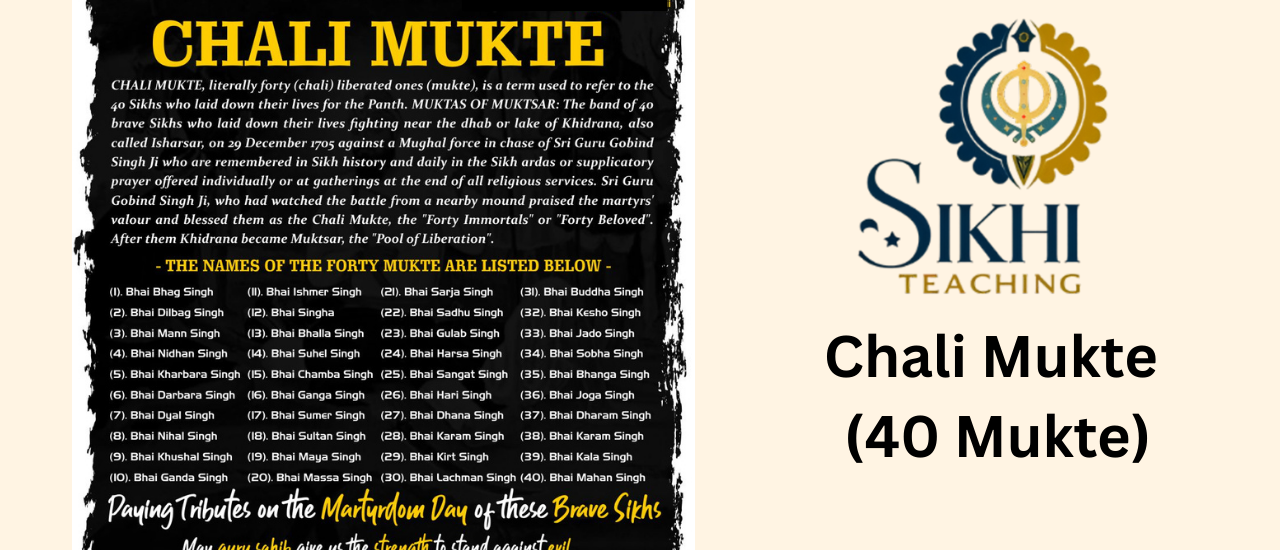
“Forty Liberated Ones” is the meaning of Chali Mukte.
This phrase refers to the forty valiant Sikh warriors who bravely fought and sacrificed their lives for Guru Gobind Singh Ji and the Sikh Panth (community) throughout Sikh history.
“Chali” means forty (40) , and “Mukte” means liberated ones—those who, via their sacrifice, were freed from fear, ego, and worldly attachments.
Historical Background
The Mughal army and hill chiefs were pursuing Guru Gobind Singh Ji, the tenth Sikh Guru, at the end of 1705 after he fled Anandpur Sahib. There were dangers, hunger, and hardships all around the Sikhs.
A number of Sikhs experienced spiritual weakness during this period. They made the decision to leave the altercation and head back home. In a document, these Sikhs declared their separation from Guru Gobind Singh Ji. This was referred to as a “bedava” (a letter of surrender).
But these same Sikhs experienced internal guilt and shame after returning home. They came to see that it was a mistake to leave their Guru. They desired to make amends and resume serving the Guru.
What is BEDAVA ? (History of Bedava)
Bedava is a term in Sikh history that means a written statement of giving up one’s claim or relationship (be=without + dava = claim). In 1705, during the long siege of Anandpur, some Sikhs became weak and asked Guru Gobind Singh Ji for permission to leave the fort. The Guru allowed them to go only if they were ready to give up being his followers, so they wrote a statement saying they were no longer his Sikhs. This document was called Bedava. Later, when these Sikhs returned, fought bravely for the Guru, and asked for forgiveness, Guru Gobind Singh Ji tore the Bedava, showing that he had forgiven them and accepted them again as his Sikhs.
The Role of Mai Bhago Ji?
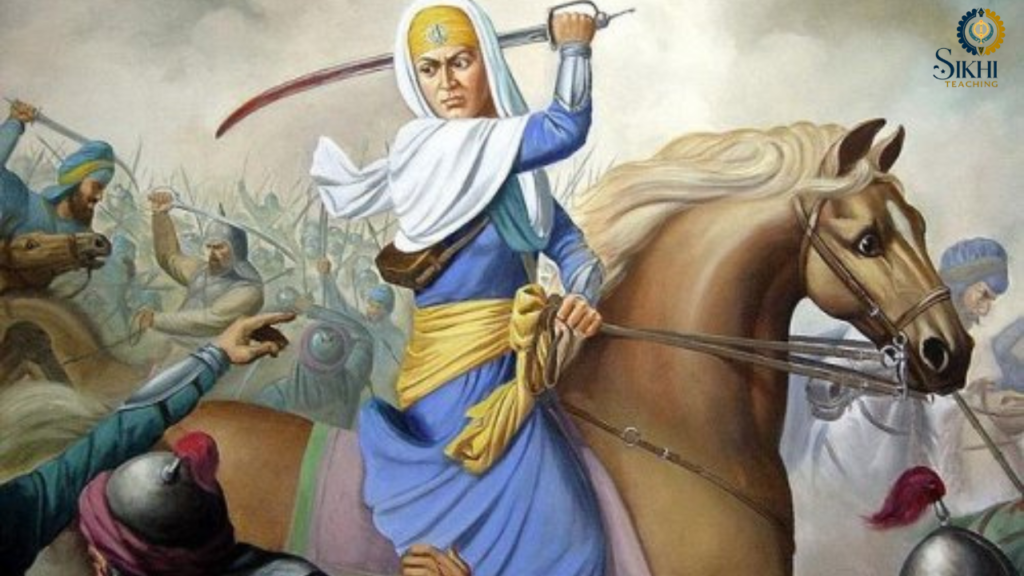
The decision to return and engage in combat with Guru Gobind Singh Ji was made by Bhai Maha Singh and the other Sikh warriors. A brave Sikh woman named Mai Bhago accompanied them. She encouraged them to come back and bravely and enthusiastically serve their Guru.
Mai Bhago is regarded as a courageous, strong woman who led the Sikhs back to the correct path. The deserters were inspired to make the biggest sacrifice of their lives by her bravery.
Battle of Muktsar – Where the Sacrifice Happened
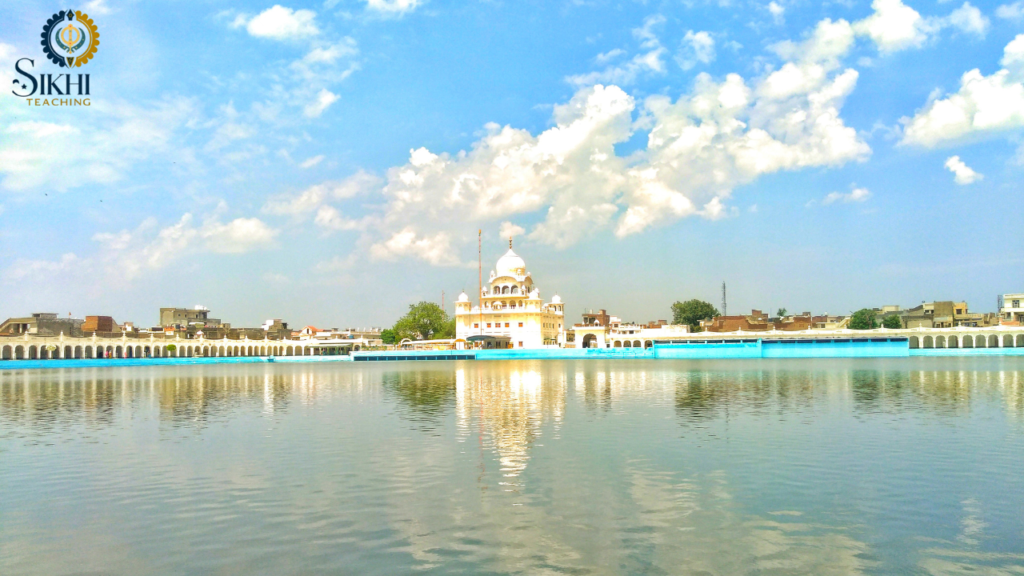
After their return, the 40 Mukte met Guru Gobind Singh Ji by the small lake of Khidrana di Dhab. Here, they faced off against a more powerful Mughal army led by Nawab Wazir Khan.
The Battle of Muktsar took place on December 29, 1705 (or, in Sikh history, 29 Poh 1762). In this battle, the forty Sikhs fought valiantly until the very end.
Despite their small numbers, the Chali Mukte (40 Mukte) fought with great bravery and determination. These courageous Sikhs gave their lives in the name of righteousness (dharma) and devotion to their Guru, which is widely regarded as one of the greatest sacrifices in Sikh history.
Bhai Mahan Singh and Forgiveness
Guru Gobind Singh Ji discovered Bhai Mahan Singh dying after he suffered severe injuries on the battlefield. Bhai Mahan Singh asked the Guru to destroy the bedava letter that the forty Sikhs had signed and to pardon them for leaving him earlier.
With complete love and compassion, Guru Gobind Singh Ji tore up the letter and pardoned them. He then referred to them as Chali Mukte (40 Mukte), which means liberated ones—those who had attained freedom in the genuine spirit of Sikh bravery and selflessness.
Why Are They Called “Mukte”?
In Sikh thought, mukti (ਮੁਕਤੀ) means getting freedom, not just in the physical sense, but also from fear, ego, and worldly attachments. Those who are spiritually free are called “Mukta.”
So, even though these forty Sikhs had once left their Guru, they returned, faced the enemy bravely, and gave their lives. Because of this final act of courage and pride in Sikh identity, they became known as Chali Mukte — the forty saints of liberation.
The Significance of Muktsar
The place where the battle was fought — Khidrana di Dhab — was later renamed Muktsar, meaning “The Pool of Liberation.”
Every year, Sikhs remember the 40 Mukte in the Mela Maghi festival at Muktsar Sahib. It is a special day where people gather, pray, and remember the bravery, loyalty, and sacrifice of these forty Sikh warriors.
Names of Chali Mukte (40 mukte)
According to Sikh records, the list of the 40 brave warriors includes names like:
(1). Bhai Bhag Singh
(2). Bhai Dilbag Singh
(3). Bhai Mann Singh
(4). Bhai Nidhan Singh
(5). Bhai Kharbara Singh
(6). Bhai Darbara Singh
(7). Bhai Dyal Singh
(8). Bhai Nihal Singh
(9). Bhai Khushal Singh
(10). Bhai Ganda Singh
(11). Bhai Ishmer Singh
(12). Bhai Singha
(13). Bhai Bhalla Singh
(14). Bhai Suhel Singh
(15). Bhai Chamba Singh
(16). Bhai Ganga Singh
(17). Bhai Sumer Singh
(18). Bhai Sultan Singh
(19). Bhai Maya Singh
(20). Bhai Massa Singh
(21). Bhai Sarja Singh
(22). Bhai Sadhu Singh
(23). Bhai Gulab Singh
(24). Bhai Harsa Singh
(25). Bhai Sangat Singh
(26). Bhai Hari Singh
(27). Bhai Dhana Singh
(28). Bhai Karam Singh
(29). Bhai Kirt Singh
(30). Bhai Lachman Singh
(31). Bhai Buddha Singh
(32). Bhai Kesho Singh
(33). Bhai Jado Singh
(34). Bhai Sobha Singh
(35). Bhai Bhanga Singh
(36). Bhai Joga Singh
(37). Bhai Dharam Singh
(38). Bhai Karam Singh
(39). Bhai Kala Singh
(40). Bhai Mahan Singh
Lessons from the Story of Chali Mukte (40 Mukte).
The story of the Chali Mukte (40 Mukte) teaches us several important life lessons:
True courage is not leaving when things are hard, but facing difficulty with full heart.
Forgiveness and love are powerful — as shown by Guru Gobind Singh Ji forgiving those who left.
Faith and devotion can change a person’s life and make them brave even in front of danger.
Conclusion – Why Chali Mukte(40 Mukte) Are Remembered Today
The Chali Mukte represent sacrifice, bravery, repentance, forgiveness, and strength in addition to being historical figures. Sikhs are not the only Indians who can relate to their story; everyone who values freedom and the truth can.
These forty heroes, who demonstrated that devotion to God and Guru is stronger than fear and death, are remembered when people discuss “Chali Mukte” today.
Frequently Asked Questions (FAQs) on Chali Mukte
What does Chali Mukte mean?
Chali Mukte means “Forty Liberated Ones.”
“Chali” means forty and “Mukte” means liberated. It refers to forty Sikh warriors who attained spiritual liberation through sacrifice.
Who were the Chali Mukte?
The Chali Mukte were 40 brave Sikhs who initially left Guru Gobind Singh Ji but later returned, fought bravely, and sacrificed their lives for him.
Why did the Chali Mukte leave Guru Gobind Singh Ji at first?
Due to hunger, fear, and extreme hardship during the siege of Anandpur Sahib, they lost courage and signed a letter (Bedava) stating they were no longer Sikhs.
Why are they called “Mukte” (liberated)?
They are called Mukte because they repented, returned to the Guru, fought selflessly, and achieved spiritual liberation through their final sacrifice.
Who led the Chali Mukte back to the Guru?
They were inspired and guided by Mai Bhago, a fearless Sikh woman who encouraged them to return and fight for righteousness.
Read Our More Blogs
Hola Mohalla History