


What Was Operation Blue Star?
Operation blue star was a military operation conducted by the Indian Army in June 1984 at the Sri Harmandir Sahib or Golden Temple .
The operation was aimed at flushing out armed Sikh militants from the Darbar Sahib complex, the Indian government said. But for Sikhs around the world, the events of June 1984 are remembered as one of the most painful and emotional moments in Sikh history.
The operation caused heavy damage to sacred buildings, loss of civilian lives, and deep emotional wounds within the Sikh community.
Background of Operation Blue Star
Why Did Tensions Rise in Punjab?
Punjab was racked by political and religious strife until 1984. Many Sikhs believed that the Indian government was denying them their rights and identity. Sikh leader Sant Jarnail Singh Ji Bhindranwale emerged as an important figure for Sikhs during this time period.
Simultaneously, the Indian government increased security operations across Punjab. They were expecting some military action, so the Sikh defenders put up a heavy guard around the Darbar Sahib complex.
June 1st, 1984 – The First Attack Begins
Indian Forces Open Fire on Sri Harmandir Sahib
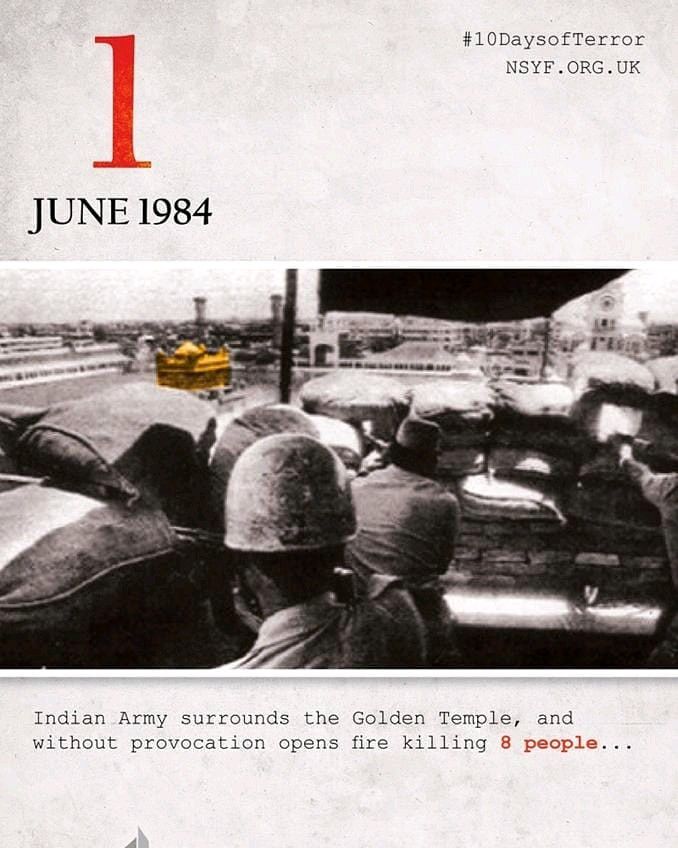
On June 1, 1984, the Indian Army and the security forces fired in the complex of Darbar Sahib. The Experts says that eight innocent civilians lost their lives in this firing.
The Sikh defenders held their ground and fired only when attacked directly. In this exchange, Bhai Mehnga Singh Ji became the first Sikh martyr (Shaheed) of the battle, from the top of Baba Atal Rai Ji’s Asthaan.
That was the start of several days of fierce fighting inside one of Sikhism’s holiest sites.
June 2nd, 1984 – Thousands Trapped Inside
Darbar Sahib Surrounded by Soldiers
2nd June it was Shaheedi Gurpurab of Guru Arjan Dev Ji. Thousands of devotees swarmed the Darbar Sahib complex to pay obeisance on this important Sikh day.
The Expertssays that the Indian Army then surrounded the complex with more than 10,000 soldiers. Many Sikh civilians and a few defenders found themselves trapped inside.
Telephone links, electricity, water and transport were said to have been cut. Media access was also severely restricted.
June 3rd, 1984 – Sikh Defenders Fight Back
General Shabeg Singh Leads the Defense
The defenders (Sikhs) had begun to fight back from 3 June, under the command of General Shabeg Singh.
The structure and architecture of Sri Darbar Sahib helped the defenders, who were aided by the elevated positions and narrow entrances.
The experts explains how the defenders used watchtowers, tunnels, and strong defensive positions to slow the advance of the army.
June 4th, 1984 – Faith and Resistance Continue
Sikh Fighters Continue Their Daily Prayers
Even though they were heavily outnumbered, the Sikh defenders continued their Nitnem, Ardaas, and prayers during the battle.
The authors of that time explains that their strength came not only from food or weapons, but from their deep faith in waheguru Ji.
During this stage of the operation:
- Helicopters and artillery were used
- Heavy gunfire continued day and night
- Water and supplies became limited
- Many Sikh fighters prepared themselves for Shaheedi
Despite the difficult conditions, many continued fighting with courage and determination.
June 5th, 1984 – Attacks Across Punjab
More Than Just Darbar Sahib
Some believed that the attack was only possible because Sant Jarnail Singh Ji was inside Darbar Sahib. However, the Sources says , “During the same period, more than 74 Gurdwaras across Punjab were also attacked.
This points to a military operation involving far more than a single location.
The fighting escalated with tanks, armored vehicles and heavy artillery moving into the complex of Darbar Sahib. The transcript states that the Indian Army met stiff resistance and suffered unexpected casualties.
June 6th, 1984 – The Final Stand at Akaal Takhat
Sikh Defenders Fight Until Their Last Breath
June 6th became the final and most intense day of the battle.
The remaining Sikh defenders regrouped inside Akal Takht for their last stand. According to the transcript, Sant Jarnail Singh Ji performed a final Ardaas and delivered his last message to the Sikh fighters.
Some Sikhs escaped in order to continue the struggle later, while many others stayed behind and fought until their final breath, attaining Shaheedi.
The Akal Takht suffered severe damage due to tank shells and heavy firing during the assault.
The Impact of Operation Blue Star
Why Is Operation Blue Star Still Remembered Today?
The events of June 1984 had a major impact on India and Sikhs around the world.
Some important consequences included:
1. Damage to Sikh Holy Sites
Parts of the Darbar Sahib complex, especially the Akal Takht, were heavily damaged.
2. Loss of Civilian Lives
Many innocent pilgrims and civilians were trapped during the operation.
3. Increased Tensions in Punjab
The operation increased anger and violence across Punjab during the following years.
4. Worldwide Sikh Reaction
Sikh communities around the world continue to remember June 1984 through events, documentaries, books, and discussions.
Why Operation Blue Star Remains Controversial
Different Views on the Events
Operation Blue Star remains controversial because different people view it differently.
Some believe it was:
- A necessary military action by the government
Others believe it was:
- An attack on Sikh faith and identity
- Excessive use of military force inside a holy place
- A tragic political failure
Conclusion
Operation Blue Star remains one of the most important and emotional events in modern Sikh history. The memories of June 1984 continue to influence Sikh identity, politics, and historical discussions even today.
Understanding these events requires studying different perspectives, historical records, eyewitness accounts, and personal stories from those who lived through that time.